
A Beautiful Place to Go Too Far: Sarah Rice's Driftless Dagger 2026 Race Recap


Sarah Rice - October 2026
A Beautiful Place to Go Too Far: Driftless Dagger 2026
550 miles through the Driftless Region of Illinois, Iowa, Minnesota and Wisconsin. Sixth overall in 57 hours, 27 minutes.
550 mi Distance
57h 27m Official time
~40,000 ft Climbing (approximate)
6th Overall

The course
The Driftless Dagger is the second Midwest Ultra Cycling race I've done, after Jack Peck's Mishigami Challenge—the race that got me started in ultra racing. Mishigami is 1,121 miles around Lake Michigan: extremely long, reasonably flat, and for much of the route relatively close to civilization. The Dagger is completely different. It is 550 miles through the Driftless Region of Illinois, Iowa, Minnesota and Wisconsin, with somewhere around 40,000 feet of climbing. It's roughly 60 percent pavement, 30 percent gravel and 10 percent evil.
There is no enormous mountain that defines the race. Instead, there are hundreds of short climbs, many of them absurdly steep, along with remote sections with infrequent resupply. The route starts at Chestnut Mountain Resort outside Galena, runs south to Savanna, crosses the Mississippi into Iowa, works north through Dubuque, Guttenberg and Lansing, continues into Minnesota toward La Crescent, then crosses into Wisconsin at La Crosse and heads south through some of the most rugged roads in the region before returning to Galena. The race description calls it “Death by a Thousand Cuts.” My Garmin counted 121 categorized climbs.
The day before the race I went out for the Friday shakeout ride and caught up with Jack for a while. That may have been some of my favorite riding of the weekend. It is hard to overstate what he has built here. The Dagger is thoughtful without being contrived, spectacularly beautiful and difficult. It is very much a world-class bikepacking race in our own backyard. Jack understands what makes the Driftless special and has put together a race that shows off the region without softening it. You could not ask for a better race or race director.

The field
Speaking of world-class, this was by far the strongest ultra field I had ever lined up against. Austin Denton had just finished second at Mishigami. Nick DeHaan is famous for an extraordinarily fast Paris-Brest-Paris and is also a formidable gravel racer. Fernando Soto had finished third at Mishigami. Riders who had done well in big events filled the field: Jesse Smith, Nathan Wentz, Travis Jolly, Zeno Molteni, and Rob MacLennan, among others. I had been a bit of a fan-girl of Rob's Instagram for a while. This was a guy I had watched ride enormous distances across continents—including riding to the Silk Road Mountain Race and then actually racing Silk Road—and suddenly he was standing on the same start line I was. A number of these riders were social-media legends to me. It was exhilarating and intimidating to line up with them while wearing the number-one cap, no less, courtesy of my fourth-place finish in the Baby Dagger the previous year.
For most of the registration period I was also the only woman signed up for the full Dagger. Then, a couple of weeks before the race, Lydia Miller threw her hat in the ring. I was genuinely grateful. It took guts to sign up for a race this hard against a field this fast, and there is substantial pressure that comes with being one of only two women in a race like this. Lydia was willing to share that pressure. She scratched in Savanna with stomach trouble—ironically, at exactly the place where I probably should have made the same decision—but I am glad she showed up and took the chance. All in all we had seven Chicago Randos in the combined Dagger races – a strong showing!
The plan
Going into the race, I had three goals. The first was to improve my moving percentage. During TransAm, only about 58 percent of my total elapsed time had been spent moving, and I wanted to get that above 70 percent. The second was to try to ride through both nights using only short naps. The third, if everything went well, was to match Andy Boone's 2025 Dagger time of 58 hours and 40 minutes.

The more I studied Andy's ride, the more I admired it. He raced the full Dagger alone on a singlespeed, slept very little and paced it beautifully. There was no competition forcing him to ride that way; it was simply a remarkably disciplined performance. I knew perfectly well that I did not have the power numbers of the fastest men in the 2026 field. If I was going to put together a respectable overall time, my strategy had to be persistence, minimal stops and minimal sleep. I wasn't going to outride those guys in watts. I was going to outlast them.
I rode a new-to-me Salsa Cutthroat for the race, with 2.35-inch tires and enormous clearance. In retrospect, I was over-biked for the conditions we actually got. The region had been hammered by rain in the days before the start, and there had been a very real chance that we would be dealing with deep mud. If that had happened, the Cutthroat would have been ideal. Instead, the roads dried remarkably well and the weather became almost perfect. I paid a penalty in weight and rolling resistance for capability I didn't need. Still, I don't think it was a bad decision. I never had a sketchy moment, never came close to wiping out, and I could descend almost anything without worrying about tire clearance or traction. At my age, getting through a 550-mile gravel race without even a near-crash counts for something. The Cutthroat and I are not completely optimized for each other yet—I would like lighter wheels, the option of somewhat narrower tires, and perhaps a suspension stem—but it is an extraordinarily capable bike.
For fuel I wanted to rely heavily on liquid calories early because they were compact, easy to carry and easy to consume without stopping. Maple syrup had worked for me during TransAm, so I planned to use syrup and Skratch through much of the first part of the race and add solid food later. I carried three 950 ml bottles because some of the gaps between my planned stops were over 100 miles. More importantly, I identified a series of contingency stops in case things did not go according to plan.
Thank God I did.
Galena to Dubuque
The first hints that something might be wrong came before the race even started. Fernando and I drove into Galena together, and I became unusually carsick on the winding roads. I wrote it off. The morning of the race my stomach still felt slightly unsettled, and Fernando and I joked that it was nerves from wearing the number-one cap. My legs also did not feel good at the start, but I was unconcerned. Ultras are not won in the first hour, and I knew I had absolutely no business participating in whatever battle was happening at the front. Austin and the other fast guys went. I didn't. In fact, I was way at the back of the field early in the race, which is unusual for me and not especially good for the ego.

By Savanna, mile 41, it was clear that I had a real problem. I stopped to use the bathroom and had significant diarrhea. I refilled everything, bought more maple syrup, and continued. After Savanna, the problem became dramatically worse. I made several emergency stops along the road. I stopped in Bellevue, both because of the diarrhea and because I was consuming fluid far faster than I had planned. Between Bellevue and La Motte it became worse still. By then it was essentially clear liquid, much more like bowel prep for a colonoscopy than normal GI upset.
In La Motte I stopped, cleaned up, refilled everything again and kept going. Between La Motte and Dubuque, the same pattern continued. By the time I reached Dubuque I had gone through nine 950 ml bottles between Savanna and Dubuque alone—more than eight and a half liters. My unusually large carrying capacity, originally intended to minimize stops, turned out to be one of the main reasons I could stay in the race. The fluid was going through me incredibly quickly, but apparently enough of it was being absorbed to keep me functional.
The FIT files make that section almost comical in retrospect. Between Savanna and Lansing I can identify about a dozen unplanned roadside bathroom stops, in addition to whatever happened at the actual town stops. During the race I had completely lost count.
Dude Wipes saved me. I could clean myself properly after every episode, and despite everything I did not end up badly chafed. I rinsed my bibs twice, which created its own saddle-comfort problems because I then had to ride in damp shorts. At one stop I bought a bag of chips, disposed of the chips and kept the bag as a trash container for used wipes. I also took my gloves off every time. None of this is glamorous, but hour after hour of severe diarrhea on remote roads makes sanitation part of racecraft. I took the time to stay meticulously clean, repeating my TransAm mantra: self-care is not optional.
One thing that helped emotionally was meeting the Baby Dagger field. The Baby route runs in the opposite direction along part of the same course, so between La Motte and Dubuque I was able to cheer for many of those riders as they came past. That gave me a little energy at a point when I badly needed it.
I was especially happy to meet Goni Halevi out there. The year before, I had ridden the Baby Dagger in 23 hours and 1 minute, fourth overall and first woman. This year Goni took down that women's FKT, finishing in 22 hours, 5 minutes. I love that. Seeing another woman come out and ride the course faster was exactly what I wanted in this race and in women's bikepacking races in general (Aside: someone please come and get the Mishigami FKT as well next year!).
I reached Dubuque around eight in the evening, near the back of the race but still remarkably close to my planned schedule. By then I was beating myself up over how slowly I was moving and having a fairly serious internal conversation about whether I possessed enough humility to finish last. That sounds ridiculous now, but at the time it mattered.
At Dubuque I switched from Skratch to BodyArmor IV and managed perhaps a third of a bag of Snap'd chips. Anything more substantial made me feel as though I might vomit.
I don't think the nutrition itself was the primary cause of the diarrhea. I had already felt wrong before the start, the diarrhea continued for many hours after I changed drinks in Dubuque, and later in the race I was again able to tolerate Skratch and other commercial drinks. Something was going on before I ever reached Savanna. Whether it was an infection, an inflammatory event or something else is still an open medical question.
The physiological marker I was watching obsessively during the race was urine. I was still peeing. I had made a rule with myself that if I stopped producing urine, I would stop racing and seek medical care. I knew that under these conditions dehydration, acute kidney injury and rhabdomyolysis were possibilities. As long as I remained mentally clear and continued producing urine, I treated the problem as something I could manage. In retrospect, that was probably too permissive a rule.
Guttenberg to La Crosse
The Kwik Trip in Guttenberg had originally been a contingency stop. I had hoped I might simply blow through town. That was no longer remotely realistic. I refueled with soup, pickles and breakfast syrup before continuing north.
Somewhere north of Guttenberg I saw what I am convinced was a mountain lion. It was about the size of a large dog but built completely differently: enormous shoulders, huge front paws, very obviously not a dog once I really looked at it. It looked at me and I looked at it, and for a moment both of us seemed to be thinking exactly the same thing:
What the hell are you doing here?
That was possibly my favorite moment of the entire race. Here was this beautiful animal that was probably a very long way from wherever it had started, trying to find its way through unfamiliar territory.
So was I.
As I worked farther north, the route became hillier and the effort became harder, but my stomach was slowly improving. By Lansing, around mile 249 and roughly twenty hours after the diarrhea had started, I could finally contemplate actual food. I ate Casey's breakfast pizza. It was wonderful. In Hokah I ate a hot dog. I am still slightly sad that my triumphant return to solid food did not happen at Free Range Exchange, the excellent bakery Travis Jolly discovered there. By La Crosse I could eat a burger. More importantly, the bathroom panic had stopped. My gut was beginning to function like a normal human digestive system again.
Throughout the first day I had exit strategies in my head. Dubuque was one: hotel, urgent care if necessary, call Eric and go home. Then I passed Dubuque. Later I had another contingency around the Prairie du Chien area. Then I passed that. When I left Guttenberg, I honestly thought there might be a fifty-fifty chance I would stop in La Crosse, where there was a real hospital if I needed one. Instead, I arrived in La Crosse, ate a burger and felt okay. So I kept going.
The bizarre part was that despite twenty hours of diarrhea, emergency stops, repeated bottle refills and virtually no solid food, I was still essentially on my planned race schedule. In fact, because I had not slept, I was ahead of it.
Chaseburg to Seneca
At Chaseburg I learned another useful lesson about recon. Two weeks earlier, I had confirmed that the gas station had an outdoor water tap. By race weekend it had been disabled for the winter. I went across the road to the Packer Bar, tipped the bartender five dollars and got my water there instead. Recon is useful. Reliance is dangerous. Nothing is guaranteed to be exactly as it was two weeks earlier.
Eventually I caught Peter Monko, one of the first tangible signs that my race was coming back together. Peter and I rode together for a while and reached Seneca. He was having trouble with his front light and needed somewhere he could sleep longer and recharge. I needed a very short nap and essentially nothing else, so our needs diverged and we parted ways.
The Seneca Post Office was perfect for me: warm, quiet and equipped with a counter I could crawl underneath so I would not immediately look like a corpse to anyone walking through the door. I set an alarm and slept for 23 minutes. It was glorious.
From there I continued to Eastman, where I had identified a vending machine during recon. The soda cost $2.00 - more than I had anticipated, but I bought what I could. Then I discovered that the bathrooms at the Eastman baseball field were open. A clean toilet. Toilet paper. A sink. Water. At that point it felt like luxury lodging. I washed my hands, brushed my teeth, filled my bottles and moved on.
The second night
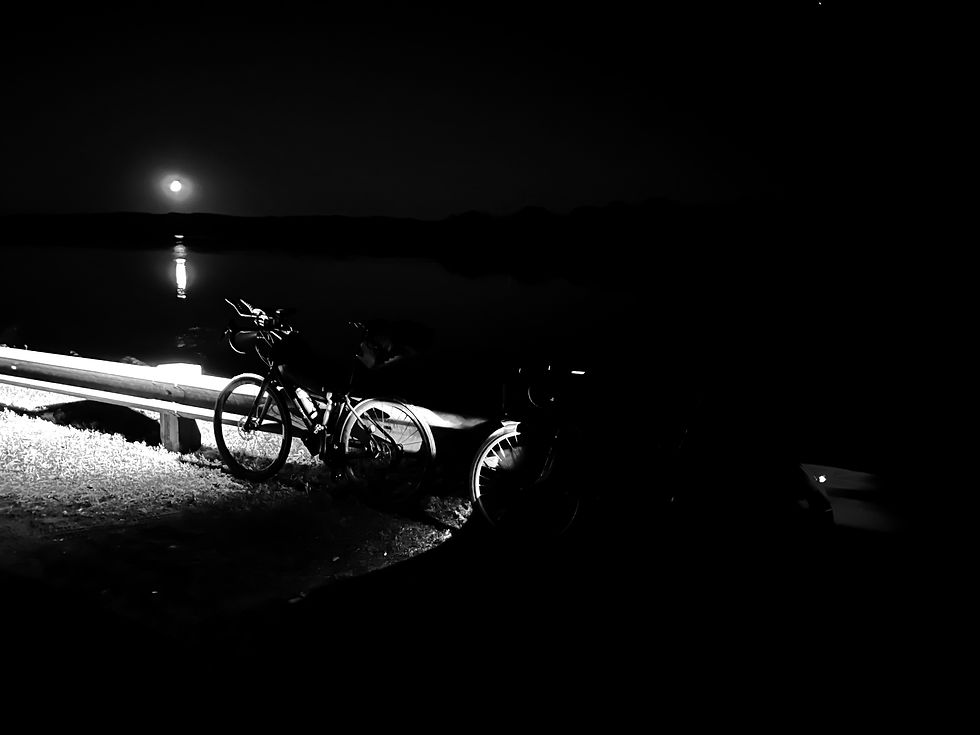
The second night was much harder than the first. I reached the Citgo near Bridgeport around three in the morning, roughly two hours earlier than my original projection and therefore well before it opened. There was no reason to wait, so I kept going. South of Bridgeport the route became remote and very cold. Temperatures dropped into the upper 30s. I put on every item of clothing I had brought, and I had packed more cold-weather gear than I thought I would need.
Eventually the sleep deprivation crossed into dangerous territory. I was listening to music and singing along to keep myself awake when I realized I was singing the wrong song—not because I had forgotten which song was playing, but because I was dreaming a different song while still riding the bicycle. I got off and walked.
One thing that made the Dagger more manageable than a long, flat road race was the constant transition between riding and walking. Some hills were steep enough that walking was simply sensible. Getting off the bicycle therefore did not feel completely foreign to the rhythm of the course.
I walked only a few minutes before finding a gravel pull-off. I had a SOL Escape Lite bivy, so I pulled it over myself, lay down on the gravel and fell asleep immediately. About fifteen minutes later I woke up shivering uncontrollably. Lesson learned: if you are cold when you go to sleep outside, you may be dramatically colder when you wake up.
I got back on the bike and warmed up on the next climb. Those pre-dawn miles were the hardest of the entire race. I was cold and exhausted. I was building a gap over Peter and Travis, but it was not enormous, and every one of those miles felt earned. By the time I reached Lancaster, there were roughly a hundred miles left. I checked the tracker and could see that sixth place was likely mine unless something went badly wrong. At Dickeyville I discovered that I had used all the caffeine I had packed. I bought a Red Bull, drank it, and that was basically enough to get me home.

The finish
The final miles around Galena are cruel. You can practically smell the finish, and then the route throws roughly another 1,800 feet of climbing at you in the last fifteen miles. I rode what I could, walked what I could not, and reminded myself that forward progress is forward progress no matter how it happens.
Jack Peck and Cody Schlabaugh met me in Galena with filming equipment in a car. Cody stuck a fuzzy microphone toward my face and I said absolutely nothing. I had no words and no energy available to manufacture any. We continued like that for several minutes until Jack finally said, “I think she emptied the tank.”
The tank had been empty since La Motte.
I finished in 57 hours, 27 minutes, sixth overall. I had achieved all three goals: more than 70 percent meaningful riding time, only three short naps totaling less than an hour of sleep, and Andy Boone's 58:40 benchmark beaten by 73 minutes. My FIT files show roughly five hours of stopped time in the entire 57½-hour race. Considering that those five hours included every store stop, every refill, all three naps and a truly astonishing number of emergency bathroom stops, I may actually be prouder of the efficiency than of the finishing time.
I also had the slowest moving pace of the finishers. That distinction may be the clearest summary of my race. I was not fast. I simply spent an enormous proportion of the weekend making forward progress.
Austin Denton, meanwhile, was competing in another universe altogether. He finished in roughly 37 hours, comfortably beating the race's 42-hour charity threshold and earning the right to direct the $10,000 charitable donation. The year before, we had wondered whether that threshold was even possible.
Finding the limit
The part I am still working through is what happened to my idea of “finding your limits.”
We romanticize that concept in ultra sports. We imagine darkness, exhaustion, sleep deprivation and heroic persistence. Maybe a dramatic crash. Maybe another facial scar. Something that looks good in a photograph.
The actual edge was considerably less cinematic.
It was behind bushes and alongside remote roads. It was sitting in gas-station bathrooms hoping I would pee to reassure myself that my kidneys were still functioning. It was rinsing bibs, rationing wipes, filling bottles yet again and calculating whether I was replacing fluid fast enough to keep going.
And then, when the race was over, it was going to the doctor.
I gained over ten pounds of fluid after the race and developed persistent fullness and pain in my upper right abdomen. The reassuring part of the initial testing is that my kidneys are completely fine, my CK did not suggest major muscle breakdown, and most of the laboratory work has been normal. However, I have fatigue, mild anemia, and significant elevations in liver and muscle-related enzymes. Because of the combination of right-upper-abdominal symptoms and abnormal liver tests, my doctor ordered additional testing and a liver ultrasound to ensure that these issues are transient and race-related. The gastrointestinal workup is continuing as well.
That is another piece of the self-care lesson. Self-care is not optional, and it does not end at the finish line. It includes Dude Wipes and clean water at mile 150. This time for me it also includes blood tests, repeat blood tests, stool samples, imaging, and follow-up appointments.
I do not think the conclusion is that I finished the Dagger and nearly destroyed my liver. We do not have evidence of that. But neither do I feel entirely good about the decisions I made.
Solving problems during races is one of my strengths. If I need water, I find water. If I cannot eat food, I find calories I can drink. If a planned water source is unavailable, I improvise. If I am sleepy, I walk. If I need fifteen minutes of sleep, I lie down on gravel.
The dangerous side of that strength is that an acute medical problem becomes another logistics problem to solve.
Profuse diarrhea becomes: How much fluid can I carry?
Inability to eat becomes: How much syrup can I absorb?
Repeated emergency stops become: How much time am I losing?
I am changing two things after this race. First, I am done carrying painkillers in ultras. I do not need to add medication-related risks to an already extreme physiological situation simply to mask pain. Second, if something happens during a future race that is genuinely outside my normal experience, I will call somebody who is not racing before deciding what to do. Not necessarily for permission to quit, but to put another brain into the decision. My medical decision-making is good in the clinic but very poor in races, and the pattern over this past season is clear enough that I should stop pretending otherwise.
There were plenty of reasons why continuing seemed rational at the time. The Dagger course was astonishingly beautiful, and I wanted to see all of it. It was the final race of my season. I had my annual PCP appointment the following day, which gave me a certain psychological permission to push harder than I otherwise might have. There was nothing else on the calendar I needed to save myself for. I remained mentally clear, I continued to urinate and ride, and after Lansing I was genuinely getting better.
The only woman left
There was also the pressure of being the only woman left.
I don't want to overstate that part of the story, but I also don't want to pretend it did not matter. I was grateful when Lydia signed up because neither of us had to carry that visibility alone. Once she was out, I knew that if I scratched there would be no woman's finish in the full Dagger, and I wanted there to be one. In a field full of riders whose accomplishments I admired, I also wanted to race well enough that my presence did not feel merely symbolic. That undoubtedly influenced how much risk I was willing to tolerate.
My thinking on that has changed. My health will not be collateral for representation. Lydia did not owe anybody a finish because she was a woman. I did not owe anybody one either. A future woman who starts the Dagger will not owe anyone a finish.

And in two important ways the weekend itself supplied the counterargument to the pressure I put on myself. Goni Halevi broke the women's Baby Dagger FKT I had set the year before. Austin chose the She Sends Foundation, which works to expand opportunities for women and girls in mountain biking, for his $10,000 charity award. The answer to being lonely in a women's field is not for the one woman who remains to treat herself as indispensable. The answer is more women racing. Someday, hopefully, women showing up for races like this will be completely unremarkable. There will be a lot of us at the start. Some will finish. Some will scratch. Somebody will break the record again. None of those outcomes will be interpreted as a referendum on women in ultra racing.
What's left
For now, what I am left with is complicated. I am extremely proud of how I raced. I paced conservatively while a much faster field disappeared up the road. I stuck to the strategy that suited my abilities. I improvised well. I kept moving. I finished sixth. I also made decisions that I would not recommend to someone else and that I do not intend to repeat.
Pride and regret can coexist.
And despite everything that happened, when I think about the Dagger I keep coming back to the landscape: the Mississippi bluffs, empty gravel roads, cold river valleys, eagles, sheep, snakes, and that improbable mountain lion looking back at me in the dark. Jack built an extraordinary race through an extraordinary place.
This was also the final race of the biggest and longest racing year of my life. When I finished, I told Jack that this had been the best season of my life, that I was stronger than I had ever been, and that the Driftless Dagger was the hardest thing I had ever done.
I meant all of it.
I suspect I am going to be absorbing what that means for quite a while.
Note added 10/12 - repeat labs and liver ultrasound normalized after a week. I'm still making phone calls when medical issues come up in future races. Thanks in advance for picking up and being my second brain if I call you.

Comments